
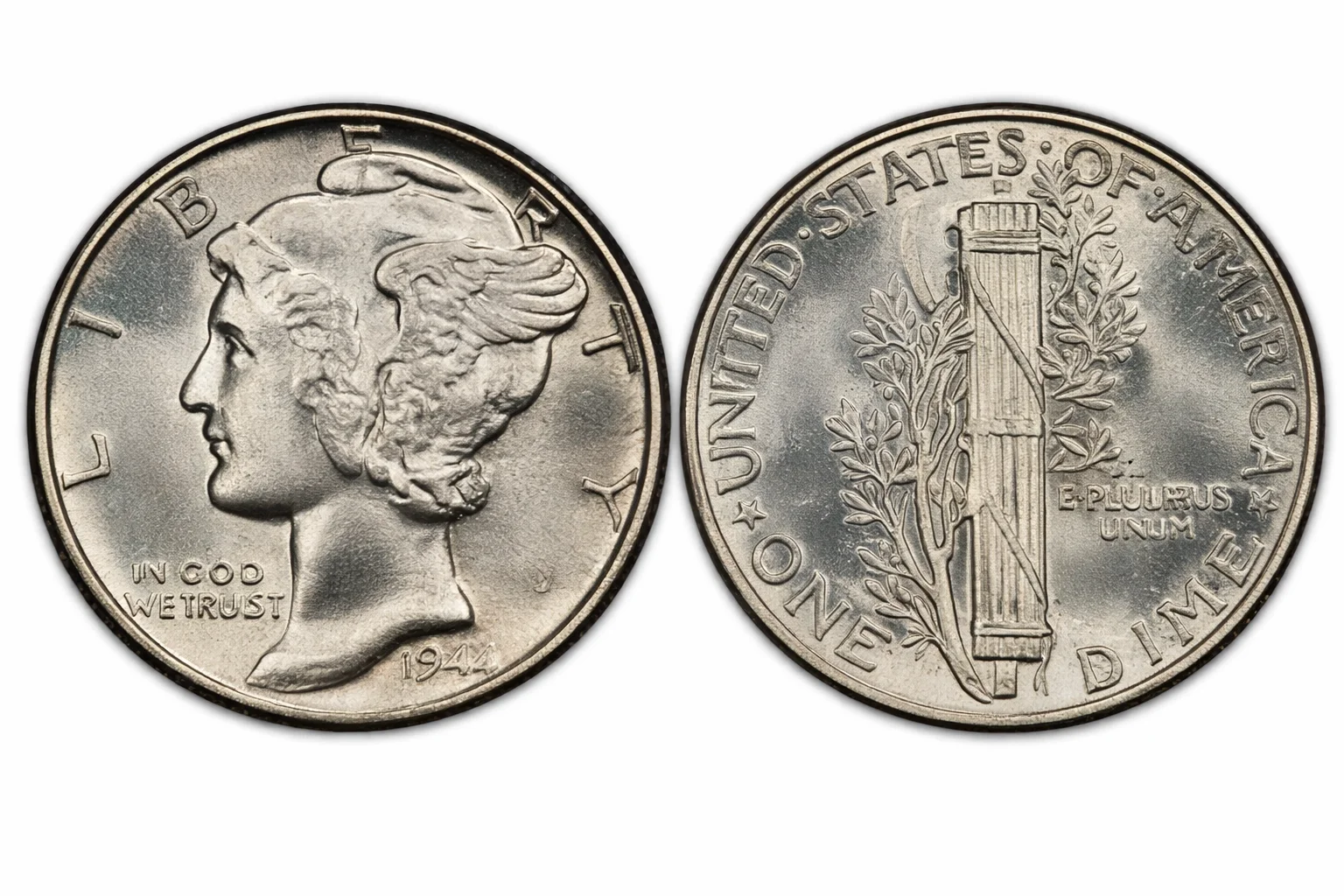
The 1944 Liberty dime is better known as the Mercury dime. Mercury does not appear on the coin. The nickname came from Liberty’s winged cap, which evoked the Roman god Mercury. The official name is Winged Liberty Head dime.
The 1944 issue was struck during World War II. It contains 90% silver. But can the coin be an investment piece?
Silver Content and Melt Value
Parameter | Value |
Composition | 90% Silver, 10% Copper |
Total Weight | 2.50 grams |
Pure Silver Content | 0.0723 troy ounce |
Alloy Type | Pre-1965 U.S. Silver Standard |
Melt value is simple to calculate: Silver spot price × 0.0723 = intrinsic metal value.
If silver trades at $25 per ounce, the melt value is roughly $1.80. If silver reaches $30, the melt floor rises to about $2.17.
This number sets the base price for heavily worn examples. No matter the condition, the silver content provides a minimum level of value.
In low grades, the coin behaves more like bullion than a collectible.
By the way, for quick technical verification of weight, composition, and type, collectors, you can try tools such as Coin ID Scanner to confirm basic specifications before deeper grading.
Circulated 1944 Dime: A Bullion-Driven Market
In grades such as Good, Fine, and Very Fine, most 1944 dimes trade near melt. Slight premiums may appear for better detail or attractive toning, but the difference is modest.
The mint mark (Philadelphia, Denver, or San Francisco) does not drastically change the price in circulated grades. All three were struck in large numbers:
Philadelphia: 231,410,000 pieces
Denver: 62,224,000 pieces
San Francisco: 49,130,000 pieces
None is scarce in worn condition. At this level, the coin is primarily valued as 90% silver. Demand comes from bullion buyers and casual collectors. Condition rarity does not apply here.
When Does Collector Premium Begin?
The market structure changes once the coin enters Mint State. Below, you can check the simplified view of behavior by grade:
Grade | Market Behavior |
G–XF | Close to melt |
AU | Slight premium |
MS63 | Clear premium begins |
MS65 | Strong collector demand |
MS67 | Major price jump |
MS67 FB | Significant multiplier |
MS68 FB | Elite rarity |
Up to AU, the silver floor dominates. At MS63, luster and preservation start to matter. At MS65, the coin moves beyond bullion logic. At MS67 and above, metal value becomes irrelevant. From this point forward, rarity is driven by condition.
Full Bands: The Premium Multiplier
Mercury dimes are judged not only by numeric grade but also by strike quality. The Full Bands (FB) designation refers to the complete separation of the horizontal bands on the fasces.
Weak strikes blur these lines. Heavy die wear reduces clarity. Many coins fail to qualify.
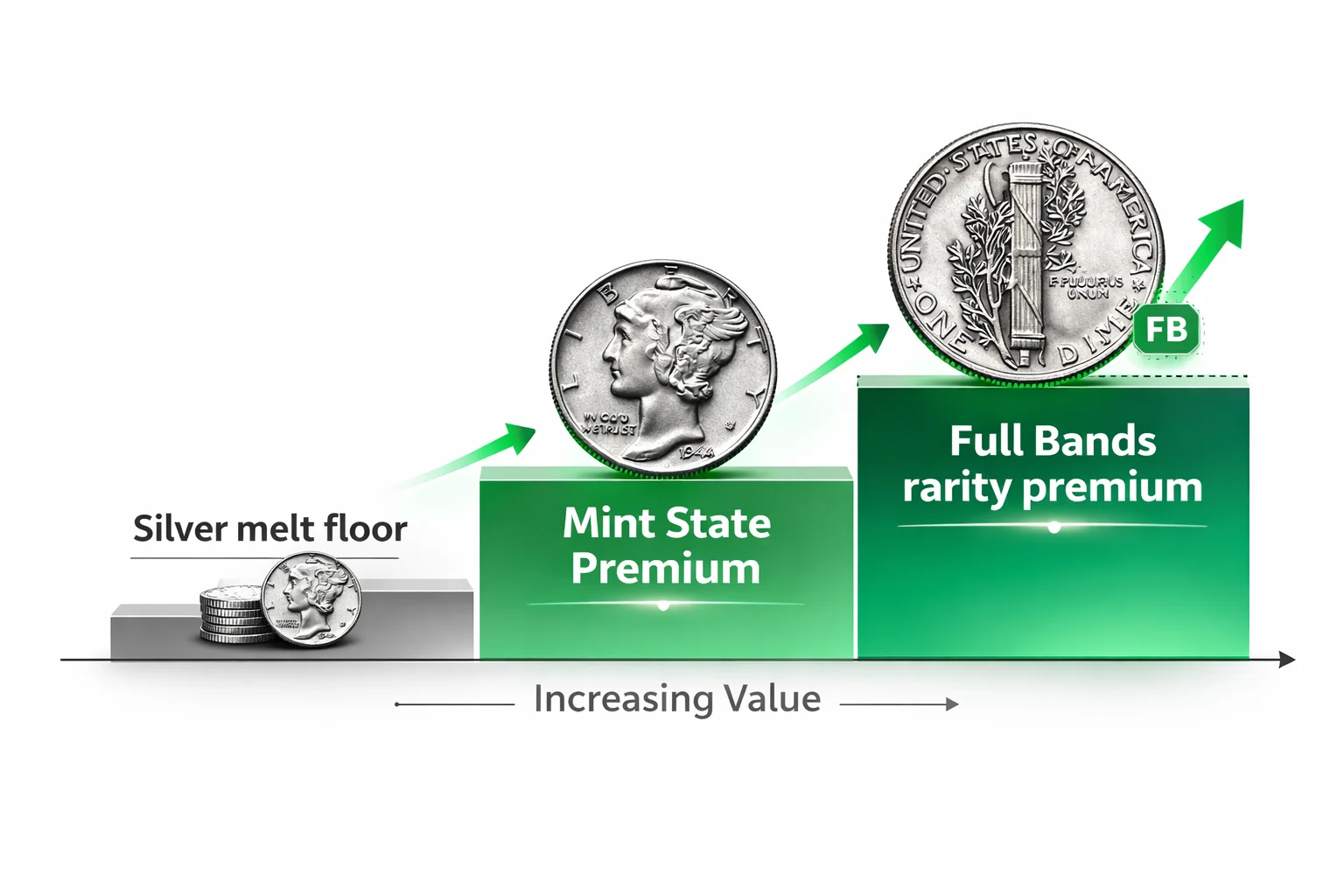
A coin graded MS67 without Full Bands may sell for a strong price. The same grade with FB can sell for multiples.
Full Bands indicate strong strike and preservation. They are far less common than regular Mint State examples.
This is where collector premium overtakes melt value completely.
Auction Evidence: Where Silver Stops
Verified auction results demonstrate this shift:
Auction Record: $1,410 for MS67+ at Heritage Auctions
Auction Record: $25,300 for MS68 FB at Bowers & Merena
These prices have no relation to silver content. At $25 per ounce, the melt value remains under $2. The rest of the price reflects rarity, certification, and competition.
An MS67+ example already sits in scarce territory. An MS68 FB is extremely rare. Few have been certified at that level.
Here, the coin is no longer bullion. It is a rare condition.
Strike Quality and Wartime Production
The 1944 dime was struck during intense wartime output. The Mint focused on volume. Dies wore quickly. Replacement cycles were short.
Common issues include:
Weak band separation
Soft central detail
Slightly muted lettering
Minor strike weakness on Liberty’s portrait
Strongly struck coins exist, but they are not the norm. That explains why Full Bands examples command such premiums.
High mintage did not guarantee high-quality strikes.
Comparing Melt-Driven vs Grade-Driven Demand
The 1944 dime serves two markets.
Bullion-Oriented Buyers
Focus on silver content.
Buy in quantity.
Ignore Full Bands.
Do not require certification.
Collector-Oriented Buyers
Evaluate strike sharpness.
Examine luster and surfaces.
Seek certified examples.
Compete for top populations.
The same coin type appeals to both groups, but the pricing logic differs completely.
In the bullion segment, silver dictates price. In the collector segment, grade dictates price.
The Role of Silver Price Cycles
Silver price fluctuations affect the lower end of the market.
When silver rises, circulated coins increase in value. When silver falls, premiums compress toward melt.
High-grade coins behave differently. An MS67 FB example does not move in direct proportion to silver spot. Its value depends on population reports and collector competition.
Metal price sets the floor. Condition sets the ceiling.
Is the 1944 Dime Better as Bullion or Collectible?
The answer depends on the purpose.
If the goal is silver accumulation, circulated examples provide efficient exposure to bullion.
If the goal is long-term numismatic appreciation, higher Mint State grades and Full Bands examples offer stronger potential.
If the goal is registry competition, MS67+ and MS68 FB pieces are the target.
The same year supports multiple collecting strategies.
Conclusion
The 1944 Mercury dime operates on two levels.
In worn grades, it is a silver coin. Melt value drives pricing. Supply is abundant. Demand is steady.
In high Mint State, it becomes a condition rarity. Strike quality and Full Bands designation determine premium. Auction records confirm the difference.
The coin’s silver content sets the base. Preservation sets the limit.
The 1944 issue proves a simple principle: quantity alone does not define value, but quality does.